The best material for a sign depends on the whole installation, not simply whether a product is described as suitable for outdoor use. The panel, finish, lettering, adhesive, fasteners, and supporting surface all contribute to the result. A durable face on an unsuitable fixing arrangement is still an unsuitable sign.
Use the material discussion to narrow the options for a specific location. Start with exposure, the intended service period, and maintenance access. Then compare appearance and cost. This guide offers a way to prepare that conversation with a fabricator; product specifications and site conditions should determine the final selection.
Write a short exposure profile
“Outside” covers a covered courtyard, a sunny wall, and an exposed roadside position. Record whether the sign receives direct rain and sun, whether water can collect behind it, and whether nearby cleaning or landscaping will affect it. Note the orientation and whether the sign sits vertically or on an angled surface.
Those details can matter to the chosen graphic system. For example, a 3M product bulletin for reflective film describes durability in relation to climate and exposure angle. That document concerns a particular product family; its service expectations should not be generalized to every vinyl film or every installation.
Indoor environments also deserve a description. A reception panel may be touched rarely, while a door sign is cleaned often and a restaurant menu panel sits near heat or grease. Ask how the sign will be maintained and what cleaning products are routinely used in the space. A finish that looks ideal in a sample may require care the operator cannot realistically provide.
Metal: specify the construction and finish
Metal can give a sign a crisp edge and a substantial appearance. But “metal sign” does not identify the alloy, thickness, finish, or supporting structure. Ask the fabricator to name the actual material and explain why it suits the location. A flat panel, folded tray, and individual letter each have different fabrication and mounting requirements.
Consider the visible surface under the intended light. A brushed finish can look quieter than a highly reflective one, but the sample should be reviewed at the site. If the sign will be coated, ask how edges, drilled areas, and attachments are treated. For exposed locations, discuss the compatibility of the selected metal and fasteners with the installer.
Maintenance access belongs in the comparison. A finish that can be cleaned at ground level presents a different ongoing task from the same finish mounted high above an entrance. Ask what is likely to need attention and whether individual components can be replaced without removing the whole assembly.
Acrylic: the grade and detail matter
Acrylic can suit illuminated faces, dimensional lettering, and interior panels. It is available in different grades and appearances, so the generic material name is only the beginning of a specification. The required thickness, method of support, and production detail should come from the supplier’s guidance and the actual design.
The manufacturer’s ACRYLITE sign fabrication guidance covers subjects including weather resistance and mounting. It is useful precisely because it addresses a defined sheet product and how it is worked. Ask the shop for comparable information for the material it proposes, especially when the sign will face heat or outdoor exposure.
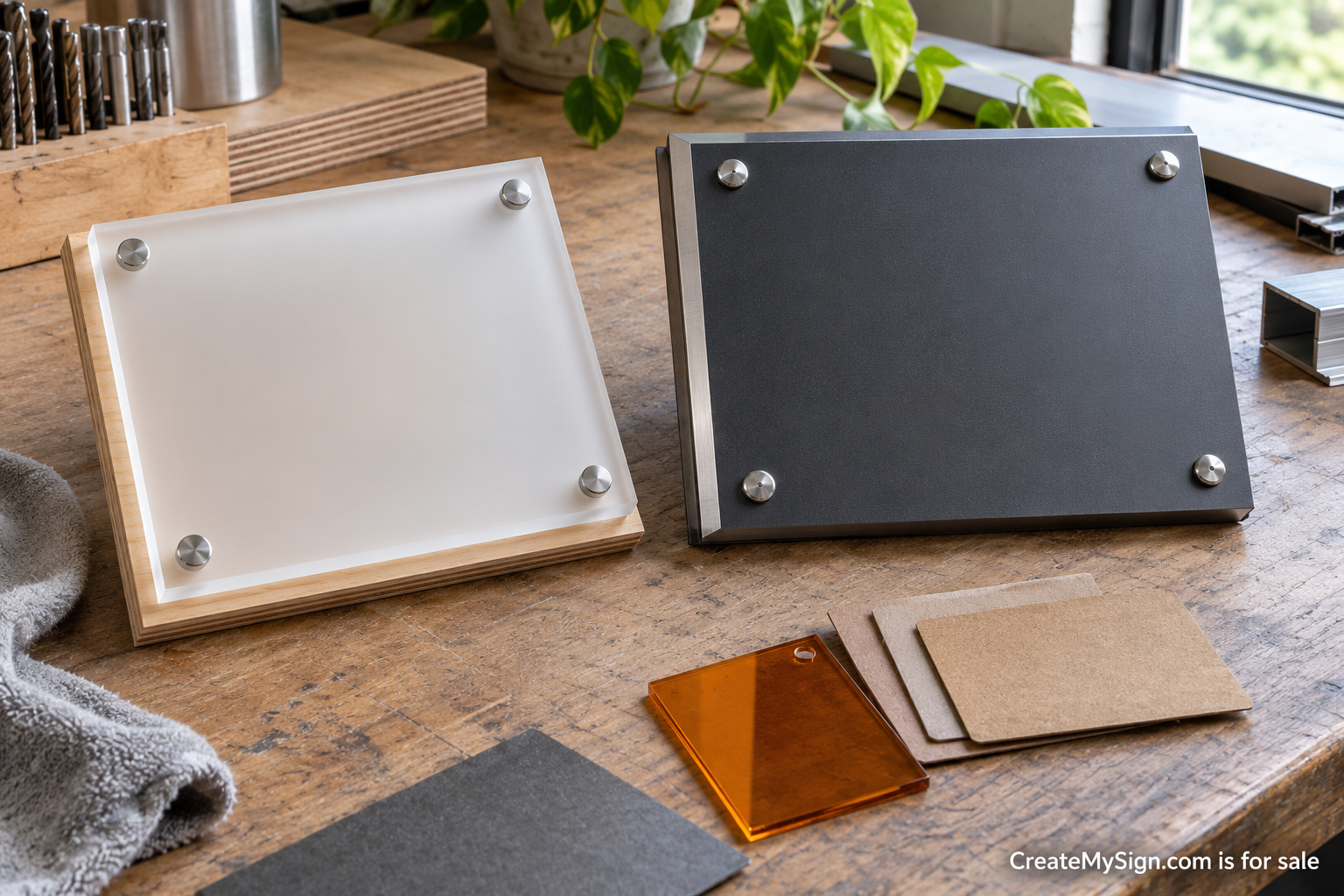
For an interior logo, compare a physical sample with the wall and lighting. Clear, frosted, opaque, and illuminated treatments create different effects. Also inspect how the sign will look from the side. Mounting hardware and stand-off distance may be as visible as the face in a narrow corridor or beside a reception desk.
Wood: decide what appearance can change
Wood brings grain and natural variation to a sign. That variation can be part of the appeal, but it should be discussed before approval. A customer expecting an exact match to a small photograph may be disappointed by a larger panel with a different grain pattern. Review a representative sample and agree which characteristics are acceptable.
For exterior use, ask the fabricator to specify the timber or board, protective finish, treatment of edges, and maintenance plan. Do not assume that a product used successfully indoors can move outside unchanged. If the desired effect is primarily visual, compare the proposed wood construction with other ways of achieving a similar appearance, while keeping the material description accurate.
A sign intended for an evolving retail interior may have a different service expectation from a permanent building identifier. Set that expectation explicitly. The question is not whether wood is universally better or worse than metal; it is whether the particular construction matches the use and the owner’s willingness to maintain it.
Film and graphics: specify the complete system
A printed or cut graphic involves more than its visible color. Identify the film, any ink and protective layer, the application surface, and the intended removal method. Ask whether the selected system is suitable for that surface and how the surface should be prepared. A smooth window and a recently painted textured wall need different consideration.
Replacement frequency changes the decision. A short promotion may prioritize straightforward removal, while permanent identification requires a different discussion. Ask what removal could involve at the end of use and whether the underlying surface may be affected. Keep the exact product details with the order so a later replacement can be assessed properly.
Use a comparison that exposes the tradeoffs
| Candidate | Question to resolve | Useful evidence |
|---|---|---|
| Metal panel or letters | Does the finish and fixing suit the site? | Finish sample and mounting detail |
| Acrylic face or plaque | Is the selected grade appropriate for the design? | Product data and fabricated sample |
| Wood construction | What variation and maintenance are acceptable? | Representative sample and care plan |
| Applied graphic film | Does the system suit the surface and service period? | Product specification and application test |
Compare quotations using the same size, quantity, artwork, and installation scope. If one supplier proposes an alternative, ask for the reason. The lower total may reflect a sensible simplification, or it may omit a task that still has to be paid for. Record the difference instead of treating every option as interchangeable.
Work through one location
Imagine a café replacing a sheltered entrance panel. The owner wants a warm appearance, expects regular cleaning, and can reach the sign only with professional access equipment. A useful shortlist might compare a specified coated metal construction with a specified wood construction. The decision should include the expected care routine and the cost of reaching the sign, not just the initial surface appearance.
Ask both suppliers to explain how their proposal addresses the recorded exposure and access conditions. Review samples in place, then confirm the selected specification in writing. Keep cleaning instructions and component details with the final proof. For the next project, the same method works again: describe the site, identify a small set of suitable systems, and choose with the full installation in view.